
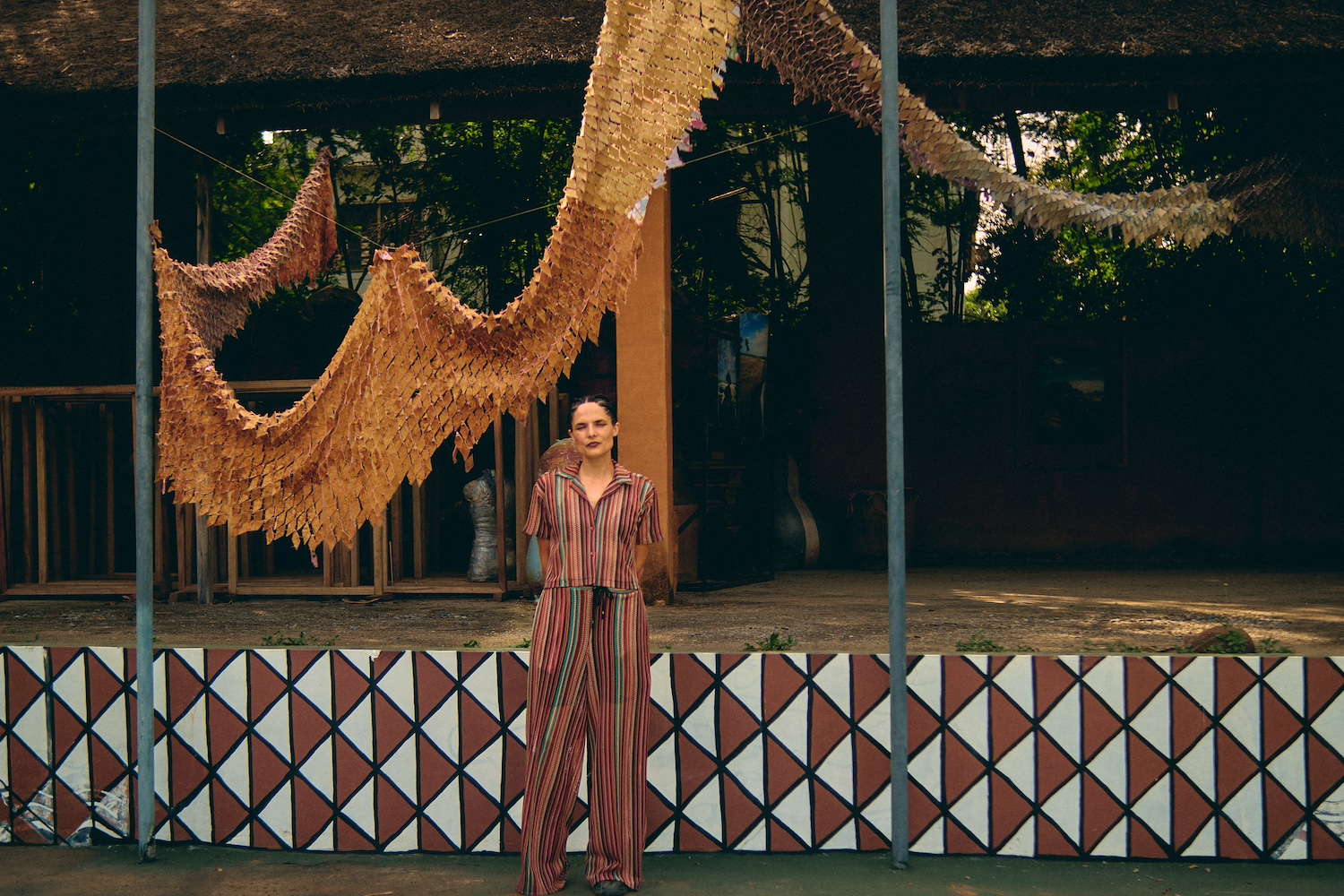
For an artist whose practice is about textile and fashion waste, a residency in Ghana allowed Dominique Lanz to gain first-hand experience of a crisis rather than looking at it from afar.
“The injustice caused by Western countries dumping their waste clothes in Ghana has been one of the foundations of my work since I learnt about. It had become urgent for me to explore the topic locally, to network and collaborate with people who live in the region and are directly affected by the current fashion system,” says the Swiss-based artist.
Using traditional and experimental textile techniques, Dominique transforms deadstock and second-hand fabric sourced from thrift store into sculptural forms that blur the boundaries between craft, technology, and ecology.
It was during her studies at Lucerne University of Applied Sciences and Arts and the Royal College of Art in London that she learnt how the textile industry was causing enormous damage. A Pro Helvetia residency (26 January to 13 April 2026) at the Kokrobitey Institute not only enabled Dominique to see the problem first hand and create a new body of work, but it also allowed her to get to know initiatives working with waste such as The Revival, The OR Foundation and the institute in Ghana. Kokrobitey Institute is “a residential learning centre that serves as both design institute and living laboratory, where we integrate traditional knowledge systems with regenerative design practices”.
It is commonly believed that 15 million second-hand clothes enter Ghana from the UK, China and US weekly. These clothes pass through Kantamanto market, one of the largest second-hand markets in the world. The Revival’s founder Yayra Agbofah says, “Kantamanto provides a livelihood for over 30,000 traders.” But not all garments in the bales are of a good enough quality to fetch premium prices and an estimated 40% end up in landfills. Added to this, Accra’s monsoons bring downpours that wash clothes waste into the oceans and giant textile tentacles clog the sea bed or wash back up on beaches.
We emailed Dominique questions about her residency in Ghana. Here are her answers:
Why do you work with discarded textiles?

The artist created work with waste textiles that examines humanity’s relationship with the environment. Image: Dominique Lanz
Discarded textiles reveal how humans are constantly striving to be beautiful, accepted, and seen; they convey so much about societies’ consumption patterns, speak volumes about so-called disposal systems, and serve as the ideal postmodern metaphor, where so-called high culture (mulberry silk fabric) and low culture (a Spider-Man bedsheet with a low thread count) collide.
Working with textiles enables me to fight injustice and continuously learn and connect with people. Textile techniques and practices are also capable of connecting with amazing people across cultures and can be reconfigured for upcycling. And finally, there is so much beauty in the ugly (sometimes disgusting and strange things that are being thrown away) and I love the challenge they present to transform them into something strange and wonderful that will catch people’s attention.
How did being in the Kantamanto market shift your view of global textile waste?
Visiting Kantamanto market didn’t shift my perspective on waste, but it made me see the problem much more clearly and made me want to share what I’ve seen.
It was an overwhelming experience to see the volumes of second-hand textiles being shipped to Ghana. It arrives early on Thursday mornings. One bale usually weighs around 50kg, and truckloads full of them are unloaded and distributed to sellers. I have a new understanding of the knowledge, strength, and resources available at the market. People have been upcycling textiles there long before the term or the concept became widely known. It’s a local practice, just as it should be everywhere. Local brands like The Revival create beautiful pieces from textile waste. At the same time, textile waste cannot be wholly managed and it’s a growing issue, despite our awareness of it.
How did Kokrobitey Institute change how you think about craft, technology and ecology?

Kokrobitey Institute is on the coast near Accra, Ghana. Image: Albert Chime
The Kokrobitey Institute showed me that in everyday life, nature and the people never cease to surprise, amaze and nurture you. Many of us have become removed from nature. Kokrobitey Institute showed me that you can relearn how to live in harmony with and through our surroundings. Also, I was fascinated by the way Renée Neblett, Esi Otoo, and the design team create clothing and accessories using traditional craftsmanship and natural materials.
Describe the body of work you created

Dominique created ‘after the flood’ which was photographed at Kokrobite Beach. Images: Michael Aboya | Aboya.8
The work created during the residency after the flood examines humanity’s relationship with the environment and views us through a posthuman lens. It plays with the concept of allomimesis and reveals that we should be part of our habitats. In biology, mimesis refers to a form of camouflage in which an organism adopts the shape, colour, and posture of its surroundings, making it indistinguishable from its environment to visually oriented predators. The idea of allomimesis is also a recurring motif in my work. This is to view us as equals, to address the destruction of our shared world, and to remind us of our dependence on a healthy ecology.
The photographs were realised in collaboration with the Accra-based photographer Michael Aboya at Kokrobite beach. Given the reality – namely, the pollution of the waterfront areas in Accra – the work alludes more to world-building and yet holds a glimmer of hope that fiction is more than just an escape. What was especially beautiful was that we didn’t just photograph the textiles I made by the sea; in a way, the textiles themselves also have their origins there. The kola and turmeric dyes were fixed in seawater at the end of the dyeing process.
What did working with kola nut, turmeric and batik unlock for you?

Dominique focus primarily on upcycling garments using the Japanese Shibori resist-dyeing technique. Image: Michael Aboya/Aboya.8
The camouflage effect on the fabrics was realised by using natural dyes as well as batik, a wax-resist dyeing technique. For the natural dye, I used kola nut, which is native to West Africa, as well as turmeric. I darkened some of the kola nut dyes using iron baths.
While experimenting with natural dyes during the residency, I became interested in what new meaning my work might take on if I considered using colour and pattern to hide and blend into one’s surroundings. I also rediscovered my love for working with my hands, with nature, and with traditional techniques – and for learning them from local experts.
What did you learn from local makers and exchanges during the residency?

The kola and turmeric dyes were fixed in seawater at the end of the dyeing process. Image: Michael Aboya/Aboya.8
I learned spontaneity and resourcefulness, and many new skills. What I found particularly striking and inspiring is how creatives empower their communities and build infrastructures for others around them to grow.
How do you balance critique of waste with a sense of possibility?

The photographs were realised in collaboration with the Accra-based photographer Michael Aboya at Kokrobite Beach. Image: Michael Aboya/Aboya.8
I get pessimistic from time to time, because the major players in the fashion industry don’t intend to change, since they’re making a lot of money. Nevertheless, we can’t just stand by and watch our world fall apart. I believe art has the power to convey a great deal without words and to move us emotionally. There is so much potential in what already exists around us and that there is so much beauty in transformation.