
The body remembers what the archive forgets. In post-Apartheid South Africa, fashion has functioned not merely as adornment but as a radical technology of self-making. What we might call self-fabulation. This is the deliberate, creative reimagining of Black identity that transforms the body into a site of resistance, memory work and futurity. From the demonised flash of Pantsula style in the townships to the global recognition of designers like Thebe Magugu, South African fashion has consistently refused containment, asserting that style is both survival strategy and revolutionary act.
To dress oneself is to claim space. Under Apartheid, when Black bodies were legislated, surveilled and controlled — their movement restricted by pass laws, their presence in certain areas criminalised — the act of adorning oneself became inherently political. Fashion was never innocent. It could not be.
amaPantsula, MaBrrr and Lebo
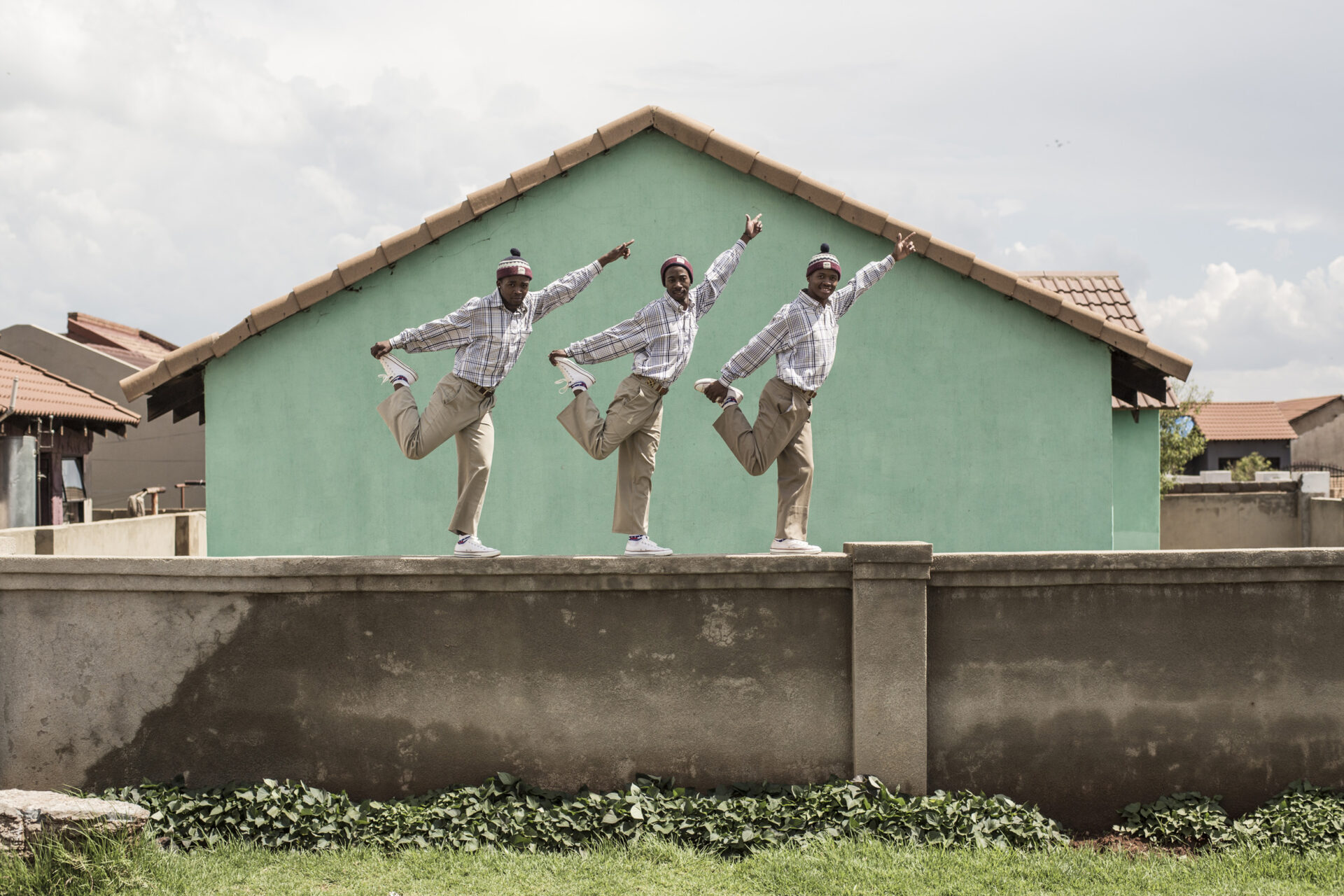
Consider amaPantsula, matsantsa if you’re from Pretoria. These working-class Black youth in the townships of Johannesburg and Soweto developed a style language so potent that it threatened the state: high-waisted trousers with sharp creases, expensive sneakers, branded sportswear stolen or saved for, hair meticulously sculpted. The Pantsula aesthetic was excess where poverty was expected, beauty where abjection was prescribed. They moved through the streets with a swagger that announced: we are here, we are styled, we refuse your diminishment.

amaPantsula like the Impilo Mapanstula colllective move through the streets with swagger. Image: Chris Saunders
The apartheid state read this as criminality. To dress well while Black and poor was to be suspect, to be targeted, to be worthy of violence. The police didn’t just see fashion, they saw refusal. They saw young Black people claiming an aesthetic autonomy that Apartheid’s architecture of dispossession had been designed to deny. Pantsula style was demonised precisely because it worked: it created alternative economies of value, alternative structures of recognition, alternative ways of being in the world that didn’t require white validation.
The same demonisation targeted Brenda Fassie and Lebo Mathosa, whose sartorial excess — short skirts, bright colours, body-revealing cuts, unapologetic glamour — refused the twin tyrannies of apartheid’s sexual regulation and Black respectability politics. Brenda’s leather jackets and platform boots, Lebo’s futuristic outfits and boundary pushing costumes, were read as moral failures rather than aesthetic innovations. They were called reckless, inappropriate, too much. What they were, in fact, was free. Or rather, fashioning freedom in a context where Black women’s bodies were subject to constant surveillance and control.

Brenda Fassie was dressing herself for a future the present had not yet authorised. Image: Wikimedia
These were not acts of rebellion against fashion norms. They were acts of self-fabulation — the creation of selves that exceeded what the dominant order had imagined possible for Black bodies. They dressed themselves into futures the present had not yet authorised.
Nontsikelelo Veleko’s counter-archive
When photographer Nontsikelelo Veleko began documenting street-style in Johannesburg in the early 2000s, she was creating what might be called a counter-archive. Her series Beauty is in the Eye of the Beholder (2003-2006) captured something the mainstream fashion industry had wilfully ignored: that Johannesburg’s streets were already a runway, that everyday Black people were already style innovators, that the aesthetic imagination of the so-called margins exceeded anything produced in the recognised centres.
Nontsikelelo’s photographs are important not because they “discovered” this style — it was already there, had always been there — but because they insisted on its visibility within institutional frameworks. She photographed ordinary people in extraordinary outfits: a man in Hillbrow wearing a perfectly coordinated three-piece suit with a fedora, a woman in Yeoville in layers of clashing prints that somehow cohered into brilliance, youth in the taxi ranks combining thrifted European labels with local tailoring and township ingenuity.
“The streets became the site where people fashioned not just outfits but entire cosmologies of self”
What Nontsikelelo documented was a culture of self-styling as epistemology. These were not people waiting to be dressed by designers. They were theorists of the body, archivists of possibility, practitioners of what Pumla Dineo Gqola calls “critical fabulation” — the creative work of imagining Black life beyond the constraints of anti-Black violence. The streets became the site where people fashioned not just outfits but entire cosmologies of self.
And crucially, much of this was achieved through thrifting. Johannesburg’s second-hand markets — from the sprawling chaos of downtown Dunusa to the organised stalls at Bruma Flea Market — became laboratories of transformation. Clothes discarded by Europe, shipped to Africa as if we were merely a dumping ground for the global North’s excesses, were remixed, restyled, recontextualised into something entirely new. What arrived as waste departed as innovation.
Global reckoning and recognition’s double edge
By the 2010s, South African designers began receiving the global fashion industry’s attention, a recognition that was both overdue and complicated. Thebe Magugu’s 2019 win of the prestigious LVMH Prize marked a watershed moment: he was the first African designer to receive this accolade. Sindiso Khumalo was a finalist in 2020. Lukhanyo Mdingi followed with LVMH’s Karl Lagerfeld Prize in 2021. Wanda Lephoto, Laduma Ngxokolo, Rich Mnisi — names began circulating in the same breath as established European houses.
But what does recognition mean when it arrives on terms set by institutions that have historically extracted from, exoticised, or ignored African creativity? It is validation, yes. It is economic opportunity in an industry notoriously gatekept along racial and geographic lines. But it is also a form of incorporation, a drawing into circuits of capital that have their own logics, their own demands.
Thebe’s work offers an instructive example. His collections often engage directly with South African history — apartheid-era documentation, family archives, the material culture of surveillance and resistance. He transforms bureaucratic documents into fabric prints, making visible the paper trail of state violence while simultaneously creating garments of extraordinary beauty. This is fashion as historiography, style as methodology for confronting difficult pasts.

A look from Thebe Magugu’s 2023 collection, Kasi Apartmento. Image: Supplied
Yet when such work enters global fashion weeks, when it is purchased by international buyers and worn by celebrities who may know nothing of the Pass Laws or the Soweto Uprising, what happens to its meaning? Does the work lose its specificity, become merely “African fashion” in the homogenising gaze of European tastemakers? Or does it force those spaces to reckon with histories they have long ignored?
These questions have no easy answers. What we can say is this: South African designers are not simply being “discovered.” They are strategically navigating global systems while maintaining connections to local epistemologies, community aesthetics and the lived realities of people who taught them that fashion is never neutral.
Contemporary fabulations and avant-garde present
In the current moment, brands like Connade are redefining what South African women’s wear can be and do. It is fashion that understands South Africa itself as an avant-garde space — a place where aesthetic innovation emerges precisely from our diversity, our multitude of languages and cultures, and ways of being in the world.

Connade is about connection to oneself, the world and the spaces we move through. Image: Dan Carter
Connade‘s work, alongside designers like Nao Serati, Mantsho, Maxhosa, Thebe Magugu, Lukhanyo Mdingi and Sindiso Khumalo, suggests that South African style resists singular definition. There is no one “African aesthetic” to be packaged and sold. There is instead a radical multiplicity, a refusal of coherence that mirrors the complexity of the nation itself. High fashion meets streetwear meets traditional textiles meets thrifted finds meets digital futurism. It is all happening at once, in conversation, in beautiful friction.
These designers are not creating a fantasy of the future but a documentation of the futures Black South Africans have been fashioning for themselves all along, in the face of every attempt to contain, control or commodify them.
Turning waste into wonder
Throughout all of these genealogies — from amaPantsula to Nontsikelelo Veleko to Thebe Magugu to Connade — runs the thread of thrifting. Johannesburg’s second-hand economy is not merely a market; it is a philosophical stance toward resource, value and transformation. When Europe sends its discarded clothing to Africa, imagining the continent as its dumping ground, Johannesburg’s style innovators perform a kind of aesthetic ju-jitsu: they take what was meant to signify our disposability and transform it into declarations of ingenuity.
This is sustainability not as trend but as necessity turned into innovation, not as greenwashing corporate strategy but as lived practice born from material conditions. The young person in Maboneng mixing a thrifted Yves Saint Laurent blazer from the 1980s with locally made pants and vintage sneakers is not performing “vintage chic” for Instagram. They are participating in a long tradition of making do, making new, making meaning from what others discarded.

Thrifting in downtown Johannesburg. Image: Wikimedia
And crucially, they are participating in environmental politics without the European moralising about “conscious consumption.” Africa contributes the least to global carbon emissions yet suffers the most from climate catastrophe. Africa is not the problem. It is, as always, the site where solutions are already being practiced, where people have long understood that nothing should be wasted, that everything can be transformed, that style and survival are not separate concerns.
The body as archive, the future as now
Self-fabulation is not about creating false selves. It is about creating possible selves, fashioning subjectivities that exceed the coordinates of anti-Blackness, that propose alternative worlds through the material language of cloth, cut, colour and combination.
“…to dress well while Black in South Africa has always been to insist on one’s humanity in contexts designed to deny it”
Every outfit assembled in a township bedroom, every thrifted find transformed through creative styling, every designer collection that refuses to flatten African complexity into consumable exoticism: these are acts of world-making. They are archives in motion, carrying forward the knowledge that the body itself can be a site of resistance, that to dress well while Black in South Africa has always been to insist on one’s humanity in contexts designed to deny it.
African fashion is not a future we are dreaming toward. It is the present we have been fabricating, thread by thread, stitch by stitch, despite and because of every structure designed to prevent our flourishing. South African fashion tells us that style is not superficial: It is survival, it is memory work, it is theory, it is resistance, it is joy.
It tells us that the future is not something that will arrive from elsewhere. It is something we have been wearing all along, waiting for the world to catch up to what our bodies have always known: that we will dress ourselves into the futures we deserve, and no amount of demonisation, marginalisation, or attempted containment will stop us from being, gloriously and unapologetically, ourselves.